Stronger Tretinoin, More Irritation: What a 48-Week Comparison Actually Found
Scientific article · Sources checked 2026-10-21
A study of two tretinoin concentrations separated visible improvement from redness and scaling. For adults weighing comfort alongside appearance, its most useful finding is also one that needs careful statistical interpretation.
An editorial review of public sources. No clinician sign-off, firsthand product test or assessment of your own treatment is claimed.
Does a stronger tretinoin cream produce a better result, or simply a more uncomfortable experience? A 1995 facial photoaging study directly compared 0.1% and 0.025% topical tretinoin with a cream base containing no tretinoin. After 48 weeks, both active creams improved overall clinical assessments compared with the base, while the higher concentration caused significantly more redness and scaling. The investigators did not detect a meaningful efficacy difference between the active concentrations.
That finding challenges the assumption that a larger concentration number necessarily means greater improvement. It does not establish that the two creams are interchangeable for everyone. This analysis uses the indexed primary report abstracts for that trial and two related studies, alongside the available official RENOVA labeling—not a review of all full articles, protocols, or supplements. The central question is narrow: what did the concentration comparison demonstrate about improvement, tissue changes, and irritation, and what remains unresolved?
The questions in this article
Study facts at a glance
Study population: The 48-week report describes 99 completers: 32 using 0.1% tretinoin, 35 using 0.025%, and 32 using vehicle. The abstract does not give the original enrollment denominator. Source 1
Clinical comparison: Both tretinoin concentrations improved overall facial photoaging compared with vehicle; the report found no clinically or statistically significant efficacy difference between them. Source 1
Comfort difference: Redness and scaling were statistically significantly greater with 0.1% than with 0.025% tretinoin. Absolute irritation rates are not reported in the abstract. Source 1
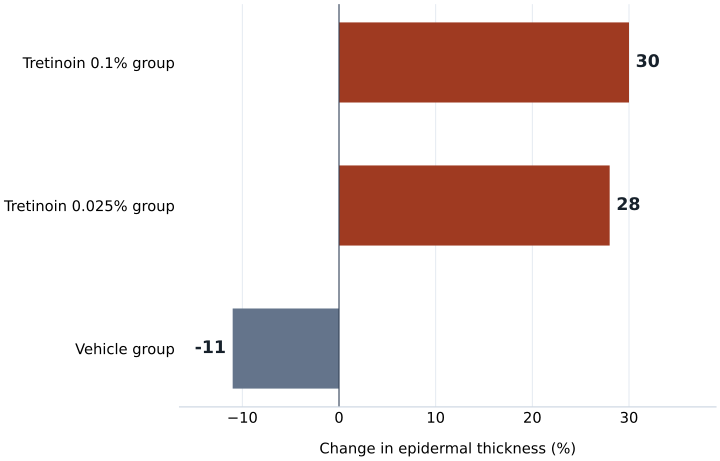
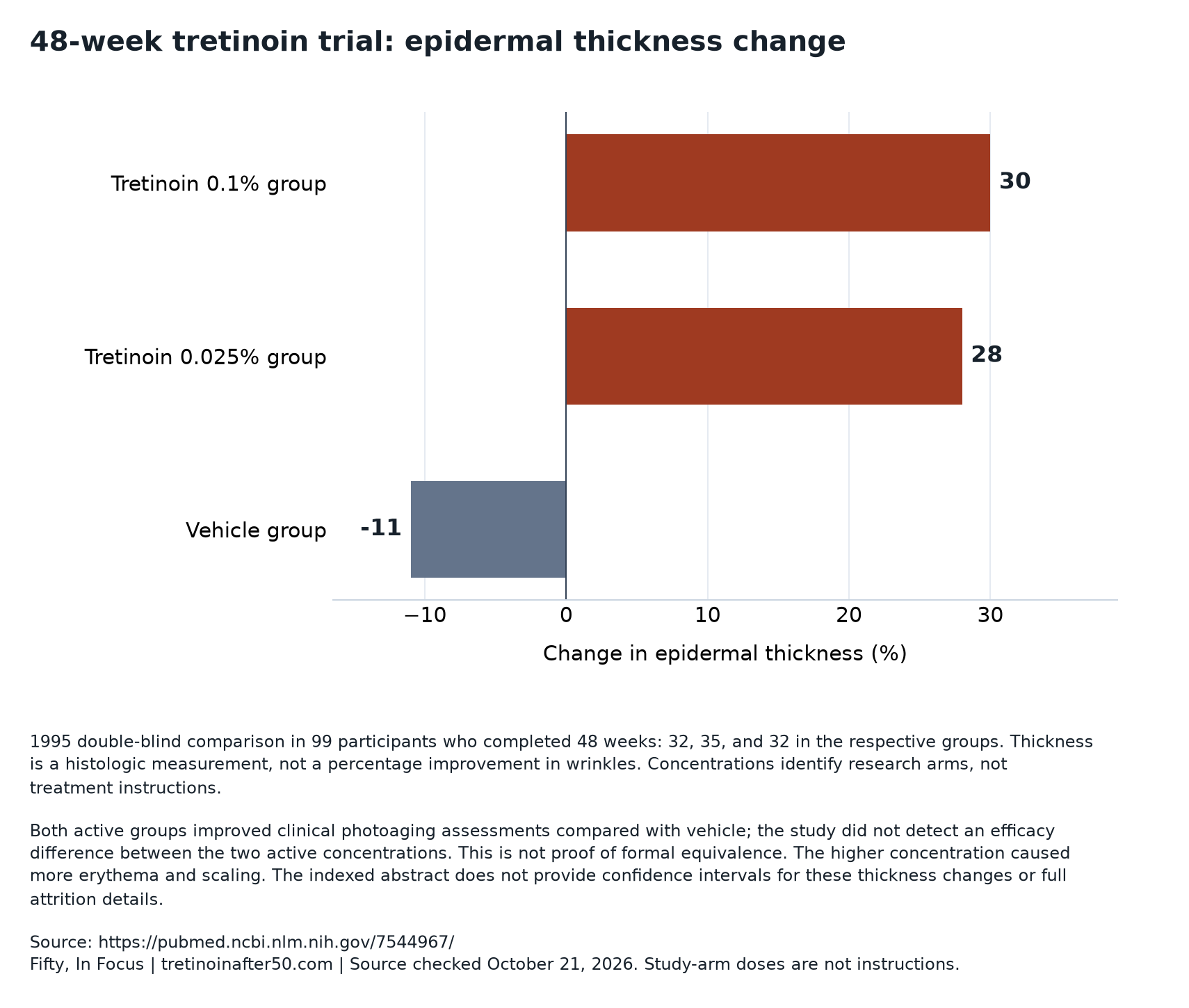
Tissue measurements: Epidermal thickness increased 30% and 28% in the active groups, while the vascularity measure increased 100% and 89%. These are not percentages of wrinkle improvement. Source 1
Product-specific labeling: RENOVA 0.02% has a specific indication for mitigating fine facial wrinkles alongside comprehensive skin care and sunlight avoidance; its label is not a blanket approval of tretinoin for reversing aging. Source 3
The experiment compared concentration, not a step-up routine
The 1995 study followed people with photoaged facial skin for 48 weeks. Photoaging refers to changes associated with chronic sunlight exposure, rather than every change that accompanies getting older. Participants used topical 0.1% tretinoin cream, topical 0.025% tretinoin cream, or vehicle once daily under double-blind conditions. These exposures identify the historical study arms; they are not a recommended personal schedule.
Vehicle means the cream base without the active drug. It is an important comparator because it helps distinguish the contribution of tretinoin from the experience of applying a cream. Double blinding means treatment identities were concealed from participants and evaluators, although conspicuous irritation could potentially make concealment harder. The abstract does not report whether blinding remained successful.
This was not a test of gradually increasing concentration, switching after an early response, or selecting a strength for an individual. It compared fixed study groups over a defined period. That distinction belongs alongside the broader questions in starting a tretinoin conversation after 50: a trial comparison is not a personalized treatment pathway.
Read the underlying chart data: download CSV or download the source-labeled chart.
Why 99 completers is not the same as 99 enrolled
The report says 99 patients completed the study: 32 in the 0.1% group, 35 in the 0.025% group, and 32 in the vehicle group. It does not say in the abstract how many originally entered, how many withdrew, or why. Calling this a study of 99 randomized participants would therefore add information the accessible abstract does not establish.
That missing denominator matters to both benefit and comfort. If people who experienced more irritation were more likely to leave, the outcomes among those remaining might not represent everyone who began. This is a possible source of bias, not evidence that such selective withdrawal occurred. Without the participant flow and analysis details, its size and direction cannot be assessed.
The abstract also does not provide age distribution, skin-type distribution, adherence results, or sponsor information. It supports conclusions about the reported photoaged population, not a demonstrated effect specifically in adults over 50 or in every skin tone. Nearly balanced completer groups are useful descriptively, but they do not resolve those missing design details.
Similar observed improvement is not proof of equivalence
Both active concentrations produced statistically significant overall clinical improvement compared with vehicle. Between the two active creams, the investigators reported no clinically or statistically significant efficacy difference. However, the abstract does not identify a single prespecified primary endpoint, reproduce the clinical scoring system, or provide numerical clinical effect estimates and confidence intervals.
A failure to detect a difference is not the same as demonstrating equivalence. An equivalence study asks whether the plausible difference lies within a predefined acceptable range. A noninferiority study asks whether one treatment is not worse than another by more than a specified margin. The abstract does not establish either type of formal testing.
The concentration was four times as high in the 0.1% arm as in the 0.025% arm. The results therefore do not support a simple proportional claim that four times the concentration delivers four times the visible benefit. They also do not exclude a smaller difference that this study could not distinguish. The sound conclusion is similar observed improvement under these study conditions, with a clearer difference in irritation.
The tissue percentages describe skin samples, not wrinkle reduction
The investigators assessed microscopic tissue features before and after treatment. Epidermal thickness—the thickness of the outer cellular layer of skin—increased by 30% with 0.1% tretinoin and 28% with 0.025%, compared with an 11% decrease with vehicle. Vascularity was assessed through dermal endothelial cell area, a measure related to cells lining blood vessels in the deeper skin layer.
The table keeps each result attached to its actual measurement. A 100% increase in the vascularity measure means that measure doubled relative to its starting value. It does not mean that skin became twice as healthy, twice as youthful, or twice as cosmetically improved. Likewise, 30% epidermal thickening is not a 30% reduction in wrinkles.
For numerical context, the reported epidermal changes differ by two percentage points between active arms; the vascularity changes differ by 11 percentage points. Those subtractions are descriptive editorial calculations, not estimates of a clinically meaningful advantage. The abstract supplies no confidence intervals for these tissue changes and no conversion linking them to an amount of visible improvement.
Reported 48-week tissue changes and their proper interpretation
| Measure | Reported change | What the number describes |
|---|---|---|
| Epidermal thickness | 0.1%: +30%; 0.025%: +28%; vehicle: −11% | Change in a microscopic skin-layer measurement, not wrinkle reduction |
| Vascularity | 0.1%: +100%; 0.025%: +89%; vehicle: −9% | Change measured through dermal endothelial cell area, not an appearance score |
| Overall clinical photoaging | Both active groups improved versus vehicle; no significant active-arm difference | Clinical assessment without numerical effect sizes in the abstract |
Redness and scaling separated from the improvement signal
The strongest concentration-related distinction was irritation. Across the reported analyses, erythema, meaning redness, and scaling were statistically significantly greater with 0.1% than with 0.025% tretinoin. The abstract does not provide the proportion affected, severity distributions, symptom duration, or discontinuation rates. It establishes the direction of the difference, not the absolute likelihood of a difficult experience.
The investigators interpreted the separation between similar improvement and different irritation as suggesting that mechanisms other than irritation dominate tretinoin-related changes in photoaging. That is a useful mechanistic clue: if more irritation did not accompany more observed improvement, irritation alone is an inadequate explanation for the result. But the trial does not prove that irritation has no role or that every individual can improve without it.
Comfort should therefore be treated as an outcome in its own right, not as a visible gauge of effectiveness. The distinction complements the practical discussion in dryness and new skin reactions after 50. The scientific point here is not a symptom-management routine; it is that a stronger irritation signal did not establish a stronger benefit signal.
The immune findings answer a narrower question
The study also examined immune-related features in skin. These included keratinocyte expression of HLA-DR and intercellular adhesion molecule-1, numbers of epidermal Langerhans cells, and epidermal and dermal T lymphocytes. In plain language, the researchers measured selected cell signals and immune-cell populations, rather than judging immune function from appearance alone.
No significant changes in those markers were found when tretinoin and vehicle were compared. That result helps define what was not detected in these measurements over 48 weeks. It does not demonstrate that every immune pathway was unchanged, nor does it establish protection against infection, skin cancer, or other disease.
Together, the tissue and immune findings illustrate why several kinds of evidence are necessary. Clinical grading addresses appearance; microscopy addresses structure; selected markers address particular biological questions. Agreement between clinical and tissue findings strengthens the observation of a treatment effect, but it does not make any one laboratory measure a validated substitute for a person's visible result.
The two-year trial adds duration, not a concentration ranking
A separate 2005 randomized, placebo-controlled study treated 204 subjects with moderate to severe facial photodamage using 0.05% tretinoin emollient cream or vehicle over as long as two years. Treatment was topical to the entire face once daily. Unlike the 1995 comparison, it tested one active concentration against vehicle, so it cannot identify which of several strengths offers the best balance of benefit and irritation.
The abstract reports significantly greater improvement with tretinoin in fine and coarse wrinkling, mottled pigmentation, lentigines, sallowness, overall photodamage severity, and investigator assessment. It gives no numerical endpoint effect sizes or confidence intervals. Thus, it supports a longer-term efficacy signal but cannot supply a percentage improvement or quantify the advantage over vehicle from the abstract alone.
Histologic examination found no increase versus placebo in keratinocytic or melanocytic atypia, dermal elastosis, or adverse effects on the stratum corneum. A procollagen synthesis marker increased at month 12 in testing at three centers. These are relevant findings, but the abstract does not provide a full adverse-event accounting. Procollagen is a biological marker, not evidence of longer survival or cancer prevention.
RENOVA 0.02% has its own evidence and safety boundaries
The official RENOVA label concerns a particular 0.02% oil-in-water cream formulation. Its indication is mitigation of fine facial wrinkles as an adjunct to comprehensive skin care and sunlight avoidance. It does not claim wrinkle elimination, reversal of photoaging, or restoration of younger skin. Findings from other concentrations and bases cannot silently broaden that indication.
The label describes almost universal reporting of one or more local reactions among 339 treated patients in controlled studies. It reports a 32% category encompassing irritation that was severe, prompted temporary interruption, or prompted mild topical corticosteroid use; this is not a 32% rate of permanent discontinuation. About 4% discontinued because of adverse reactions. These figures belong to the labeled formulation, not the 1995 concentration arms.
Other boundaries include pregnancy restrictions, heightened sunburn susceptibility, potential interactions with photosensitizing medicines, and substantial local irritation. Safety and effectiveness beyond age 71 are not established in the label. Its longer-duration cautions should be read alongside—not replaced by—the separate two-year study. Bausch Health US LLC is the listed labeler; the indexed research abstracts do not identify trial sponsors.
The study in adults averaging 87 tested retinol on arms
A 2007 trial provides evidence in substantially older adults, but it answers a different question. Thirty-six residents of two senior facilities, with a mean age of 87, entered a randomized, double-blind comparison of 0.4% retinol lotion and vehicle on opposite arms. Study personnel applied the products up to three times weekly for 24 weeks. Retinol is not tretinoin, and arm skin is not facial skin.
Fine-wrinkling scores changed by −1.64 points with retinol, with a 95% confidence interval of −2.06 to −1.22, versus −0.08 points with vehicle, with an interval of −0.17 to 0.01. The scale ran from 0 to 9, with lower scores representing less severe wrinkling. These are score changes, not percentages. The analysis carried the last observation forward for missing later measurements, which assumes that observation adequately represents the missing endpoint.
Biopsy findings came from very small subgroups: six for glycosaminoglycan expression and four for procollagen I staining. They cannot establish prevention of skin injuries or ulcers. Our closer reading of the older-adult retinol trial examines those distinctions; the comparison below shows why the studies should not be merged into a strength ladder.
Different evidence sources answer different questions
| Evidence | Population and comparison | Question it addresses |
|---|---|---|
| 1995, 48 weeks | 99 completers with facial photoaging; 0.1%, 0.025%, and vehicle | Observed efficacy and irritation differences between two tretinoin concentrations |
| 2005, up to two years | 204 subjects with moderate to severe facial photodamage; 0.05% emollient cream versus vehicle | Longer-term effects of one specific tretinoin study formulation |
| 2007, 24 weeks | 36 older adults, mean age 87; 0.4% retinol versus vehicle on opposite arms | Retinol effects on naturally aged arm skin |
| RENOVA labeling | Specific 0.02% cream and its clinical program | Product-specific indication, reactions, and limits |
A concentration number is not a complete care proposition
Editorial interpretation: the 1995 findings make concentration alone a weak basis for judging the value of a care offer. A larger number did not demonstrate superior improvement in this comparison, while irritation increased. That supports asking what outcome is being assessed and how discomfort is documented, rather than assuming strength itself proves better care.
The guide to comparing tretinoin options after 50 and questions for a longer treatment plan address those documentary distinctions. For a provider-specific reading, the Dermatica review and Musely review can be used to check written consultation, follow-up, and contract terms—not to infer that either reproduces these study formulations or outcomes.
The unresolved scientific questions remain substantial: how precise was the active-arm difference, how did withdrawals affect it, and which patient characteristics influenced tolerance? Clinical results do not automatically transfer to a provider, compounded mixture, different base, oral route, or another formulation. A useful evidence comparison keeps the ingredient, formulation, body site, population, and outcome attached to the finding.
Questions about the evidence
Did the 48-week study prove that 0.025% works as well as 0.1%?
It found similar observed clinical improvement and no clinically or statistically significant efficacy difference. That is not formal proof of equivalence or noninferiority. The abstract does not provide the necessary predefined margin, confidence interval for the between-group clinical difference, or detailed analysis plan. It does provide evidence against assuming that the higher concentration necessarily produced a visibly better result.
Does more peeling mean tretinoin is producing more improvement?
Not according to this comparison. The higher concentration caused more redness and scaling without demonstrating greater clinical improvement. That weakens the idea that irritation is a dependable measure of benefit. It does not prove that irritation never contributes to treatment effects or establish what a particular person's symptoms mean.
Were wrinkles reduced by 30% in the trial?
The reported 30% figure concerns increased epidermal thickness in the 0.1% group, not wrinkle reduction. The corresponding increase with 0.025% was 28%. The abstract reports overall clinical improvement but supplies no percentage reduction in wrinkles. Microscopic structural changes and visible appearance scores are different outcomes and should not be substituted for each other.
Does the two-year study settle long-term safety?
It adds useful controlled evidence for a specific 0.05% emollient formulation, including reassuring findings on the examined tissue abnormalities. It does not settle safety for every formulation, population, or duration. The abstract lacks detailed adverse-event rates, while RENOVA 0.02% labeling retains its own product-specific duration limits and warnings. Neither source establishes skin-cancer prevention.
Can the retinol trial in very old adults identify a gentler substitute for facial tretinoin?
No direct substitution claim follows. The trial tested a different ingredient and lotion on arms, with staff applications and a different follow-up period. It was not a head-to-head comparison with facial tretinoin and does not provide a comparative irritation estimate. Its contribution is evidence of improvement in fine-wrinkling scores on naturally aged arm skin under its own study conditions.
What this evidence supports
The 48-week concentration study offers a specific, useful finding: more concentrated tretinoin caused more irritation without demonstrating greater clinical improvement. Its tissue measurements support biological activity but do not quantify wrinkle reduction. Missing enrollment, withdrawal, and precision data prevent a stronger equivalence claim. For mature adults, the practical editorial lesson is to keep comfort beside appearance as a separate outcome—not to treat discomfort or concentration as proof of effectiveness. Related studies extend the evidence to longer treatment and older arm skin, but neither removes the boundaries around the original comparison.
Research access and limitations
Research analysis is based on three indexed primary-report abstracts and the available full official RENOVA label. Full research articles, protocols, and supplements were not examined. Trial funding, detailed participant flow, and several endpoint and adverse-event estimates are not available in these abstracts.
The sources behind the discussion
- Two concentrations of topical tretinoin (retinoic acid) cause similar improvement of photoaging but different degrees of irritation. A double-blind, vehicle-controlled comparison of 0.1% and 0.025% tretinoin creams. ↗Indexed original research abstract · Accessed 2026-10-21
- Long-term efficacy and safety of tretinoin emollient cream 0.05% in the treatment of photodamaged facial skin: a two-year, randomized, placebo-controlled trial. ↗Indexed original research abstract · Accessed 2026-10-21
- DailyMed: RENOVA tretinoin cream 0.02% ↗Exact FDA-approved product labeling; record updated February 24, 2026; internal revision November 2025 · Accessed 2026-10-21
- Improvement of naturally aged skin with vitamin A (retinol). ↗Indexed original research abstract · Accessed 2026-10-21