Retinol at an Average Age of 87: What a 24-Week Arm-Skin Study Found
Scientific article · Sources checked 2026-10-21
A small paired-arm trial found improved fine-wrinkle scores with a specific retinol lotion. Its age-specific contribution is important—but the score changes, tiny biopsy subsets, and arm-to-face differences need careful interpretation.
An editorial review of public sources. No clinician sign-off, firsthand product test or assessment of your own treatment is claimed.
One of the more distinctive retinol trials enrolled 36 adults with a mean age of 87. Rather than testing a facial routine, researchers compared a retinol lotion with its inactive base on opposite arms over 24 weeks. The study offers direct evidence that fine-wrinkle appearance in naturally aged skin can respond to topical retinol well into later life. It does not establish that every retinol face product produces the same result, or that people sharing an age category share the same skin needs.
The most useful reading separates three kinds of evidence: a clinical wrinkle score, laboratory findings from very small biopsy subsets, and a proposed benefit for resistance to injury that was not actually measured. This analysis uses the indexed primary research abstracts and the available official RENOVA labeling, not a review of all full articles, protocols, or supplements. That access supports a detailed account of the reported results while leaving important questions about tolerability, missing observations, and individual responses unresolved.
The questions in this article
Study facts at a glance
Participants: The retinol trial included 36 adults residing in two senior facilities; their mean age was 87. Source 1
Paired-arm comparison: Study personnel applied 0.4% retinol lotion or its vehicle to opposite arms, up to three times weekly for 24 weeks. Source 1
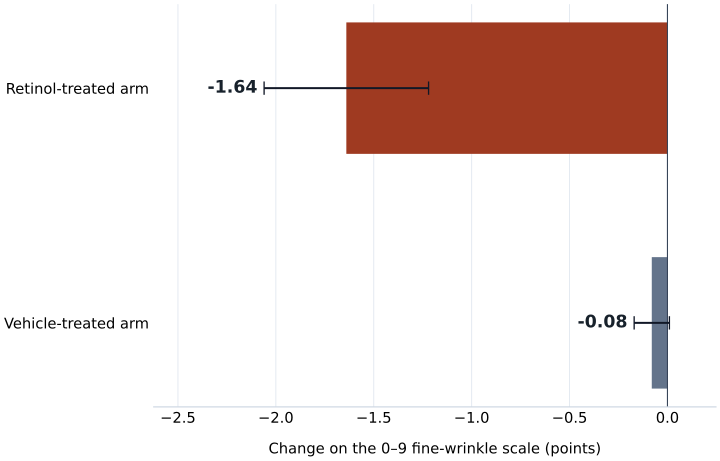
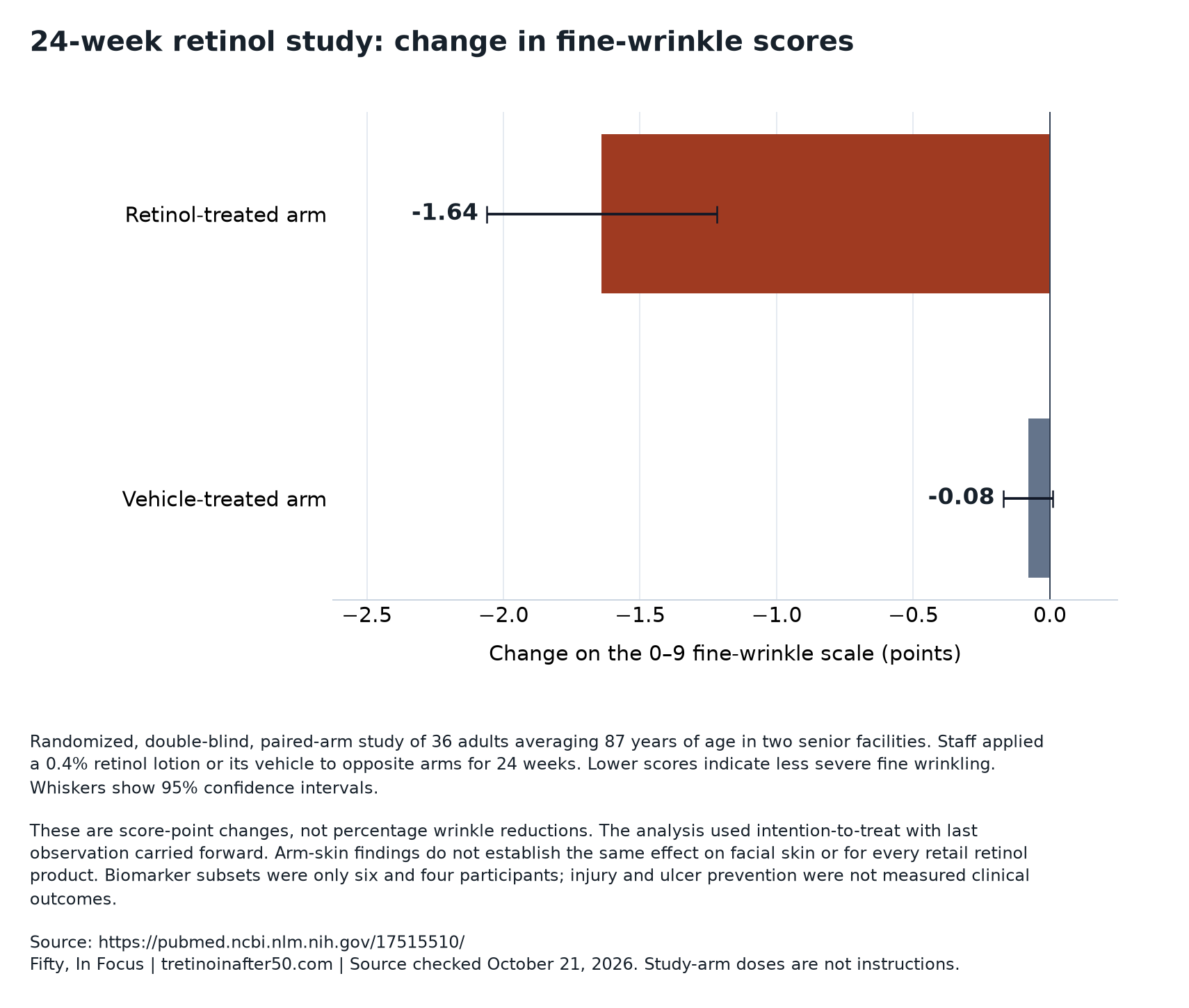
Clinical result: Fine-wrinkle scores changed by −1.64 points with retinol versus −0.08 with vehicle on a 0–9 scale; these are score points, not percentage reductions. Source 1
Biopsy evidence: Glycosaminoglycan findings came from six participants and procollagen I findings from four—not all 36 participants. Source 1
Safety boundary: The retinol abstract does not provide complete adverse-event counts. Irritation findings from tretinoin studies or labeling cannot be assigned to this retinol lotion. Source 1 Source 3 Source 2
Why this population adds something unusual
Kafi and colleagues’ 2007 report studied naturally aged skin in 36 residents of two senior facilities. The mean age of 87 makes it particularly relevant to a population often missing from cosmetic claims. An average, however, is not an age range: the abstract does not establish how widely participants’ ages varied or how many occupied particular age bands.
The setting also matters. Applications were performed by study personnel, rather than left entirely to participants at home. That creates a more supervised exposure than an ordinary retail skincare routine. It helps test the lotion under the study’s conditions, but does not tell us how consistently the same exposure would occur outside that arrangement.
An important interpretation follows: this is evidence about a defined group and skin site, not a biological profile of everyone over 50. The abstract supplies too little detail about health conditions, skin characteristics, or selection criteria to determine which differences among older adults might alter response.
Read the underlying chart data: download CSV or download the source-labeled chart.
Opposite arms created a useful internal comparison
The trial was randomized, double-blind, vehicle-controlled, and conducted within each person. One arm received topical 0.4% retinol lotion and the other received its vehicle—the lotion base without retinol. Random assignment of treatment side helps prevent systematic left-versus-right differences from favoring one treatment. Double-blinding is intended to reduce expectations influencing treatment or assessment.
A paired design has a practical advantage: each participant supplies their own comparison. Age, general health, and many personal characteristics are shared across that person’s two arms. The relevant contrast is therefore not simply whether one group of people improved more than another, but whether retinol-treated skin changed differently from vehicle-treated skin within the same participants.
This does not turn 36 participants into 72 independent people. Measurements from two arms belonging to one person are related. Nor does the abstract describe enough methodological detail to audit the randomization procedure, allocation concealment, or success of blinding. The design is informative, but its label alone does not answer every question about execution.
The tested exposure was a lotion, not a general retinol routine
Study personnel applied the retinol lotion and vehicle at visits, up to three times a week for 24 weeks. The concentration and schedule identify the experimental arms; they are not instructions for adopting that regimen. The phrase up to also matters: it does not establish that every participant received exactly three applications in every week.
The comparator was not untreated skin. Using a matched lotion base asks whether adding retinol produced an additional effect beyond that base under the study conditions. This is a more specific question than whether applying any skincare product is better than doing nothing. It also limits how much the result says about a different formulation.
Retinol is not retinoic acid, the compound also called tretinoin. Their percentages cannot be treated as interchangeable measures of clinical strength. For readers considering the broader prescription discussion, the guide to expectations when starting a tretinoin conversation after 50 provides a separate framework; this arm study does not validate a prescription routine.
Reading the wrinkle result in its actual units
Clinical assessment used a semiquantitative scale running from 0, meaning none, to 9, meaning most severe. Semiquantitative means the score grades severity rather than measuring wrinkle depth in a physical unit. Lower scores indicate less severe wrinkling. At 24 weeks, the reported mean change in fine-wrinkle score was −1.64 with retinol and −0.08 with vehicle.
The difference between those reported changes is 1.56 score points favoring retinol: −1.64 minus −0.08 equals −1.56. This arithmetic describes the separation of the reported means. It is not a separately reported adjusted estimate, and the abstract does not give a confidence interval for that difference.
The retinol change had a 95% confidence interval of −2.06 to −1.22; the vehicle change had an interval of −0.17 to 0.01. The reported comparison had P<.001. Together these support a treatment-related difference in the measured score. They do not reveal how many participants considered the change worthwhile, how many improved substantially, or whether the result looked equally noticeable in everyone.
The reported fine-wrinkle result, with the units kept intact
| Measure | Reported result | Meaning |
|---|---|---|
| Fine-wrinkle scale | 0–9; lower is better | A severity rating, not a percentage or wrinkle-depth measurement |
| Retinol mean change | −1.64 points; 95% CI −2.06 to −1.22 | Average improvement in retinol-treated arm skin |
| Vehicle mean change | −0.08 points; 95% CI −0.17 to 0.01 | Little average change in vehicle-treated arm skin |
| Difference of reported means | 1.56 points favoring retinol | Editorial arithmetic; no confidence interval for this difference is supplied |
| Reported comparison | P<.001 | Statistical evidence of a difference, not its personal importance |
Why −1.64 does not mean a 64% wrinkle reduction
A score change must retain its unit. The decimal digits in −1.64 do not encode a percentage, and dividing by the nine-point maximum would not establish a percentage reduction in wrinkles either. The scale is an ordered clinical rating, not a count of wrinkles or a direct quantity of damaged tissue.
A percentage change would require an appropriate starting value and a meaningful proportional interpretation. The abstract does not supply the baseline fine-wrinkle means needed even for a simple baseline-relative calculation. More fundamentally, a change from one severity category to another need not represent the same physical change everywhere on the scale.
The result is still useful without a dramatic percentage. It shows an average shift toward less severe fine wrinkling relative to the vehicle. What remains missing is a bridge between that numerical shift and everyday significance: participant-rated benefit, a threshold for meaningful improvement, and the distribution of responses are not reported in the accessible abstract.
The missing-data method deserves its own reading
The authors reported an intent-to-treat analysis using last observation carried forward. Intent-to-treat generally aims to retain participants in the analysis according to their assigned treatment. Last observation carried forward fills a later missing assessment with the person’s most recent available measurement.
That method does not demonstrate that everyone completed 24 weeks. For example, if a late visit were missing, an earlier score could stand in for the later value. This is an explanation of the method, not evidence that a particular participant missed a visit. The abstract does not provide the number, timing, or reasons for missing observations.
The assumption matters because skin could continue improving, remain stable, or worsen after the last recorded assessment. Carrying a score forward may misrepresent any of those trajectories; its bias is not automatically conservative. Without completion counts or alternative analyses, the strength of the reported result cannot be fully tested against different assumptions about missing data.
Small biopsies support a hypothesis, not an injury-prevention claim
The biopsy findings were much smaller studies within the clinical trial. Retinol-treated skin showed greater glycosaminoglycan expression than vehicle in a subgroup of six, with P=.02. Glycosaminoglycans are molecules associated with water retention in the skin’s supporting environment. Procollagen I immunostaining increased in a subgroup of four, with P=.049; immunostaining uses antibodies to detect a tissue marker.
Those results are compatible with changes in skin matrix biology, but they are not measurements from all 36 participants. The abstract gives neither percentage increases nor confidence intervals for these markers. It also does not explain enough about subgroup selection to establish how representative the sampled participants were. A P value does not supply the missing magnitude or show uniform response.
The authors proposed that increased matrix synthesis might help aged skin withstand injury and ulcer formation. That was a biological hypothesis, not a measured clinical outcome. The report does not establish fewer ulcers, fewer tears, stronger healed wounds, or reduced injury rates. Even a plausible marker cannot substitute for a trial that actually counts those events.
What the accessible evidence says about irritation
The retinol abstract does not supply complete adverse-event counts, irritation severity, or discontinuations attributable to treatment. It therefore cannot support an assertion of zero irritation or universal tolerability. It also does not permit calculation of an irritation rate for this particular lotion. Absence of a safety table in an abstract is not a finding that adverse effects were absent.
Separate evidence shows why tolerability belongs beside efficacy. In a 48-week facial photoaging study completed by 99 patients, 0.1% tretinoin caused significantly greater erythema and scaling than 0.025%, despite similar reported clinical improvement. These are actual irritation findings, but they concern tretinoin creams, not the retinol arm lotion. Our close reading of that concentration trial examines the distinction.
The official RENOVA 0.02% label likewise documents local reactions, including peeling, dryness, burning, stinging, redness, and itching. About 4% discontinued because of adverse reactions. Those figures apply to that labeled cream’s studies, not retinol. The guide to dryness and irritation after 50 helps organize the questions without treating all reactions as ordinary aging.
Facial tretinoin studies answer different questions
The 48-week concentration trial compared daily topical 0.1% and 0.025% tretinoin creams with vehicle in facial photoaging. Both concentrations improved clinical assessments relative to vehicle, without a clinically or statistically significant efficacy difference between them. That finding does not establish equivalence to 0.4% retinol, because the drug, formulation, site, population, and follow-up differ.
A separate two-year trial treated 204 participants with moderate to severe facial photodamage using daily topical 0.05% tretinoin emollient cream or vehicle. It reported greater improvement in several clinical signs and no increase versus vehicle in specified histologic abnormalities. Procollagen marker findings at month 12 added biological evidence. The abstract does not provide effect sizes or confidence intervals for the clinical improvements.
Neither study ranks retinol against tretinoin. The two-year abstract’s reassuring findings on examined tissue features also do not erase local irritation risks or establish safety for every formulation. Concentration-specific studies, product labeling, and an individual treatment discussion are different evidence layers—not interchangeable certificates of benefit.
Three trials that should not be collapsed into one retinoid claim
| Study | Exposure and comparison | Question it addresses |
|---|---|---|
| 24-week retinol study | 0.4% retinol lotion versus vehicle on opposite arms; 36 adults, mean age 87 | Fine wrinkling in naturally aged arm skin under staff-applied treatment |
| 48-week tretinoin study | Daily 0.1% or 0.025% facial tretinoin versus vehicle; 99 completers | Clinical response and irritation across two tretinoin concentrations |
| Two-year tretinoin study | Daily 0.05% facial tretinoin emollient cream versus vehicle; 204 participants treated | Longer-term clinical and histologic findings in moderate to severe facial photodamage |
Translating the finding to face products after 50
The strongest transfer is conceptual: later-life skin retained a measurable response under these conditions. The weaker transfer is product-specific. Arm findings do not automatically predict facial benefit, and the studied lotion does not stand for every over-the-counter retinol cream. Nor do the clinical results automatically transfer to compounded products, oral routes, different formulations, or services that cite retinoid research.
Age-specific labeling illustrates the boundary. RENOVA 0.02% labeling says participants aged 65–71 did not show a significant difference in fine-wrinkle improvement compared with younger participants, while safety and effectiveness above 71 were not established. That is a statement about this exact tretinoin cream’s evidence. It neither contradicts nor extends the retinol study in adults averaging 87.
Editorial interpretation: comparing an offer with research requires checking the exact formulation, follow-up arrangements, and documentary terms rather than treating a citation as proof of a service’s outcomes. The tretinoin options guide frames those questions. The Dermatica review and Musely review are places to check documented terms, not evidence that either reproduces this trial. Trial sponsorship is not identified in the accessible retinol abstract; the RENOVA label’s named packager, Bausch Health US LLC, should not be mistaken for the retinol trial’s sponsor.
Questions about the evidence
Does the average age of 87 make this stronger evidence for every older adult?
It makes the study unusually direct evidence for its participating older population, but not universally representative evidence. Mean age does not describe the full age distribution, medical diversity, or skin characteristics. The paired-arm design strengthens the treatment comparison within participants; it does not remove uncertainty about transferring the result to other people, settings, or body sites.
Did retinol improve wrinkles by 64%?
No. The reported change was −1.64 points on a 0–9 fine-wrinkle severity scale. Vehicle-treated skin changed by −0.08 points. These are changes in a clinical rating, not percentages of wrinkles removed. Neither the decimal digits nor the scale maximum provides a valid shortcut to a percentage reduction.
Did the biopsy results prove that collagen caused the wrinkle improvement?
No. Increased procollagen I immunostaining in four participants supports a biological hypothesis, but does not establish the causal contribution of collagen to the clinical score change. The abstract does not report a participant-level relationship between marker change and wrinkle response. The separate glycosaminoglycan finding involved six participants and likewise does not prove a mechanism.
Does the trial show that retinol prevents skin ulcers?
No. Greater resistance to injury and ulcer formation was proposed as a possible consequence of changes in the skin matrix. Ulcer prevention was not a reported measured clinical outcome. Demonstrating that benefit would require evidence tracking injuries or ulcers, with an appropriate comparison and enough follow-up to assess their occurrence.
Can the two-year tretinoin trial settle long-term safety for this retinol lotion?
No. It studied a different compound and formulation on facial photodamage, not the 24-week retinol arm intervention. Its specified histologic findings are informative for that study, but cannot fill in missing retinol adverse-event counts or establish long-term retinol tolerability. Likewise, a research abstract is not current prescribing information for a separate product.
What this evidence supports
The 24-week study provides credible, narrowly defined evidence of improved fine-wrinkle scores with a particular retinol lotion in naturally aged arm skin among adults averaging 87. Its paired design is a strength, and the difference from vehicle is more informative than an uncontrolled before-and-after claim. The numerical outcome remains a score change, not a percentage transformation. Very small biopsy subsets suggest biological activity without proving the mechanism or injury prevention. For readers after 50, the study expands what age-specific evidence includes; it does not turn age, a retinol percentage, or a research citation into a reliable prediction for a facial product or care service.
Research access and limitations
This analysis relies on indexed primary research abstracts for the three trials and the available full official RENOVA label. Full trial protocols, supplements, participant-level data, detailed retinol adverse-event counts, and missing-data sensitivity analyses were not examined. The accessible retinol abstract does not identify trial sponsorship.
The sources behind the discussion
- Improvement of naturally aged skin with vitamin A (retinol). ↗Indexed original research abstract · Accessed 2026-10-21
- DailyMed: RENOVA tretinoin cream 0.02% ↗Exact FDA-approved product labeling; record updated February 24, 2026; internal revision November 2025 · Accessed 2026-10-21
- Two concentrations of topical tretinoin (retinoic acid) cause similar improvement of photoaging but different degrees of irritation. A double-blind, vehicle-controlled comparison of 0.1% and 0.025% tretinoin creams. ↗Indexed original research abstract · Accessed 2026-10-21
- Long-term efficacy and safety of tretinoin emollient cream 0.05% in the treatment of photodamaged facial skin: a two-year, randomized, placebo-controlled trial. ↗Indexed original research abstract · Accessed 2026-10-21